
Caminos in the (MDS) Desert
Every minute of every day the Ultramarathon scene is getting more and more popular.
There are BCN Backyards with 10000 people registering for 170 places. Events like Western States requite almost ten years solid of ballot places. Even local trail races can be hot tickets (like Camino Epping in October).
Through all the mayhem there are small bunch of ultras that have been around for almost fifty years and their popularity shows zero sign of diminishing.
Whatever you think about the 'toughest or most brutal' there is no doubt that Marathon Des Sables is still the no.1 ultra when people who don't know about the sport are asked if they have ever heard of one.
If you take part in MDS you are guaranteed to meet runner friends for life.
As a Coaching team we love MDS.
If you live in UK and especially in a city like London then the training environment challenges are massive
Cold vs Desert Heat
Concrete jungle vs MDS sand dunes
Gails and Cafes on every corner vs 'shall I take a stove and how much food will I eat over the week'

Camino Derrick has been coached by us for a few years.
He has mastered distance and terrain and been successful in every ultra we've done together. So whilst some of the elements of MDS may not have concerned Derrick his attention to detail and specific training for the multi-staged desert adventure showed all the same level of care and passion.
We are always learning things as coaches. We loved coaching Anna Brown to her MDS desert adventures and we loved experiencing new things with Derrick.
We asked him to share all the warts from his version and we are grateful we can share with all you Caminos. If you are considering this race for 2027 or similar multi-staged ultras and want to have a chat about how we can help - DM us and let's enjoy some wild successes together.
Over to Camino Legend Derrick:

MDS Legendary 2026
Day 4 about 9pm, somewhere in the Sahara desert. The heat of the day has long gone, I’ve been feeling nauseous for a while and stopped eating and drinking. My energy is low and I’m wobbling a bit on my feet. I drink some water, get my poles out and keep walking. My world has shrunk to a little patch of sand lit up by my headtorch. It’s only 12km to the finish of the 100km Long Day, but I am utterly spent and will have to force some fuel down to get me there.
I remember seeing the Marathon Des Sables on TV when I was a teenager. TransWorld Sport, Channel 4 early on a Saturday morning. The very idea of it seemed superhuman, not something I could ever do.

Yet many years later here I am. Having a challenge motivates me to train and I like to build my resilience and to push myself. I could just do the SouthDowns Way 100 again, but MDS entries were open and I felt it was time to take on what would be my toughest challenge yet. I’ve always enjoyed an adventure, from climbing in Ireland and Scotland, an expedition to the Arctic when I was a student, to aid work in Afghanistan and Africa when I was in my twenties and more recently the Arc of Attrition. I felt ready for another adventure, but I also knew I would have to train hard, do lots of research and nail down my kit, nutrition and hydration strategy.
2026 was to be the 40th edition of what is now known as MDS Legendary. Often described as the toughest foot race on earth. It’s 250km, 6 stages over 7 days. Stage 4, the Long Day has the following day as a rest day if you complete it within 1 day, or you have up to 40 hours to complete it over the 2 days. The longest stage is typically 85km but as a special treat for the 40th edition the organisers increased the distance to 100km. So, this year we would be covering 270km. Stage 1 was 35km, Stage 2 40km, Stage 3 30km, Stage 4 100km, Stage 5 42km, and Stage 6 23km
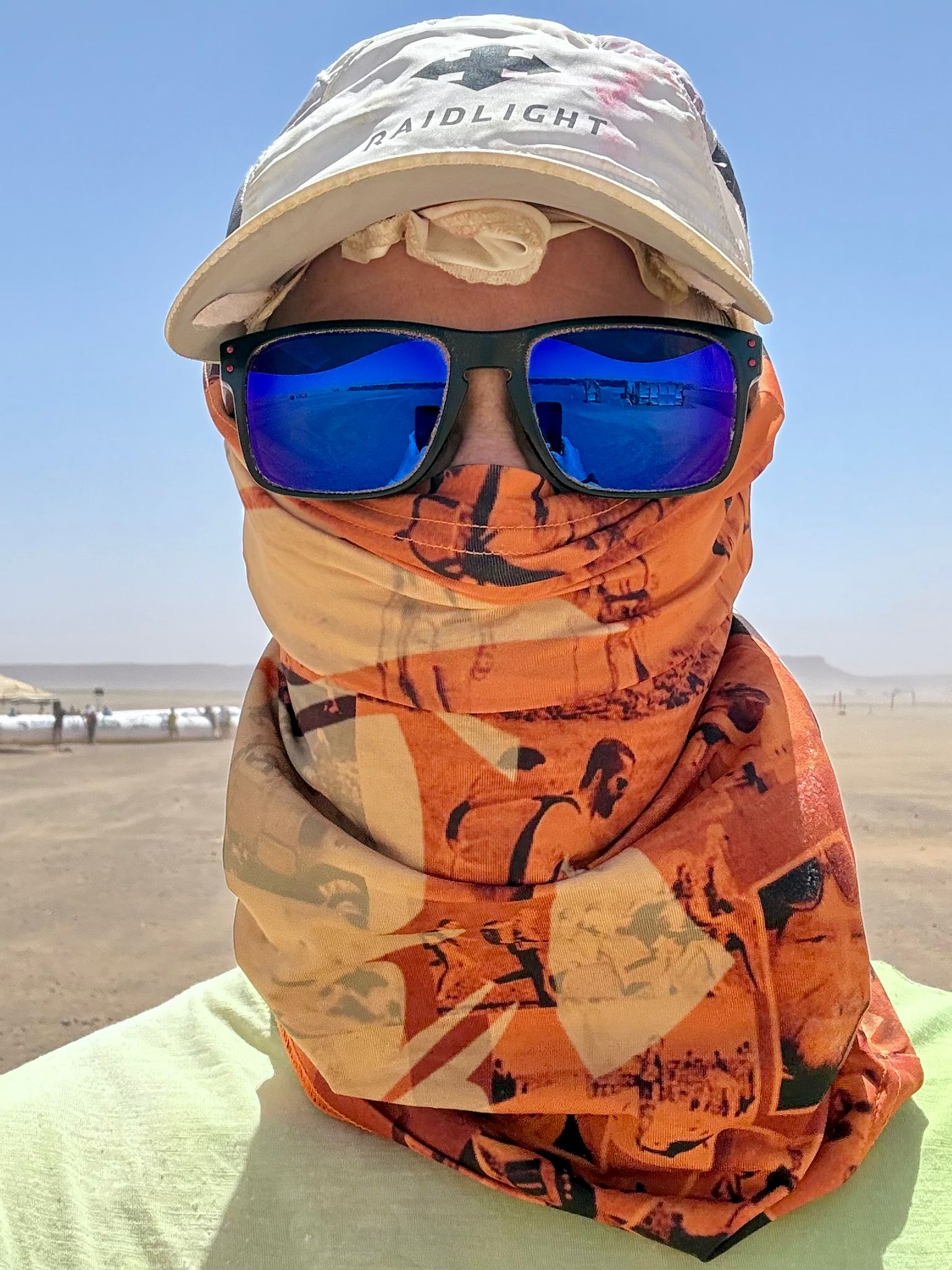
Runners are self sufficient; you carry everything you need apart from water and a tent. Berber open sided tents are pitched each night and you share with the same 7 other participants. Temperatures can climb to over 40C, yet it can get cold at night. Sandstorms add to the harsh conditions.

People think the route is all sand but the terrain is mixed. The most runnable sections look like the surface of Mars, hard packed sand and lots of small rocks. It’s more difficult to get traction on the soft sand and dunes but you get into a rhythm and learn how to run in the sand. Dried up river beds (Wadis) are like highways as are the salt flats. Jebbels are rocky mountains to be climbed and scrambled up.
MDS isn’t just a race, it feels like an expedition as you move through and sleep in the beautiful but harsh desert environment. Literally and metaphorically it’s a journey. You learn a lot about what both your body and your mind can cope with.

For me the actual running was fine, I was well trained and strong. It’s the combination of the physical effort with the hot conditions, restricted food, and poor recovery after an uncomfortable night in the bivouac that made it tough for me.
Every day started in the dark with the red glow of headtorches. We were woken by a loud “GOOOD MORNING BIIVVOOOAUCC” from the start line PA system, in the style of Robin Williams in Good Morning Vietnam. Woof down some freeze-dried porridge that I had left to rehydrate overnight, eating straight from the plastic bag. Not much pleasure in it, just fuel, and no coffee! Get all the kit packed up and a slow painful walk to the start line via the toilet block. Every morning my legs were stiff and sore until I got moving and then they were fine. A short motivational Speech in French and English and we were off to the tune of AC/DC’s Highway to Hell.
Checkpoints were frequent, usually 6-8km apart. Refill water bottles, get some iced water poured down you neck and wet your hat and buff. Not sure it had much impact on my core temperature, but it felt good for 5 minutes. Best thing about the checkpoints was the support from the blue jacket volunteers and the orange jacket medics.
On the long day a few checkpoints had treats: lemons, dates, soup, a deck chair, some Moroccan tea, a biscuit. For those coming in at night a camp fire and tents you could sleep in.

Keeping properly hydrated was key, plenty of water with sodium. As a very salty sweater I used PFH1500 sachets, which served me well. The organisers made you carry two stock cubes per day as mandatory kit. We quickly discovered they made a great cold drink or we just ate them as what we dubbed “oxo biscuits.” I tried to consume 60g carbs per hour when running, along with with the PFH sachets I rotated Veloforte, Voom and Phoenix bars and many PFH chews.
Almost everyone, including me, got multiple blisters. Mine gave me no trouble, I usually didn’t even realise I had them until the end of the stage. Then off to the medical tent where after washing your feet (which was one best things every day) you would pop your blisters with a syringe and inject a red antiseptic which got everywhere staining hands and feet.

Mindset was key. No matter the distance, I raced checkpoint to checkpoint. I tried to keep my heart rate low. At times with the heat and the terrain this meant I was moving at a slow pace, but at other times I was able to run at a good steady clip. Every runner had their name, number and country flag on the back of their packs. As I passed people I would try to work out which country they were from, most were British, French, Belgian or Dutch, but there are still some flags I need to look up.
Crossing the line each day you had some Moroccan tea, were able to refill your water bottles (1.5L), get some iced water poured on your head and neck, then off to collect your 5L water ration so you had 6.5L to last until the first checkpoint the following day. It was enough, although to be honest, I didn’t wash much, I dread to think what we all smelt like.
The weight of your pack makes a big difference. Mine was 8.6kg at check in, over half of which was food. As each day progressed it got lighter and by stage 5, the Marathon Day, I barely realised I was wearing it.

We climbed a few really high and steep dunes, these were hard work going up, often on hands and knees on the steepest sections, but were fantastic fun running down.
I managed to complete the last 12km of the long day having forced down a Lime PFH chew which got me to the finish lines at 11.15pm. Plenty of time for a poor uncomfortable night’s sleep and to rest all the following day.
A real high point for me was on the evening of day 5 when the last two runners finished the Long Day. Fanny and Marc walked in together having been going for just under 39 hours. In what is an MDS tradition, all the runners and volunteers went to the finish line to cheer them in. It was very moving, and most people including me got a bit teary as they crossed the line. I felt very humbled by their determination and endurance. I’m pleased to say both completed the race.
Did I come out of the desert a different person than I went in? No, nothing that clichéd. But I am astounded by what we can achieve with planning, preparation, execution, determination and support. I was a well prepared experienced ultra runner, but many competitors were not, yet they pushed through, sometimes in terrible pain with horrendous blisters and injuries. One man even completed the entire race in a navy suit, white shirt and tie.

Is it the toughest foot race on earth? Maybe, but it’s about so much more than the running. It’s the lack of food, the restricted water, the heat, the cold, the wind, the sand everywhere and in everything, poor sleep, discomfort, exhaustion and pain. It’s also about the beauty of the desert, the camaraderie, the new friendships, the mix of nationalities, and the support all the runners and volunteers provide to each other.
Above all else, it’s the resilience to get up every morning to get yourself to that start line and to keep moving forward no matter what the Sahara throws at you. The DNF rate is only about 5%, the organisers do everything they can to get you to finish.
On the last day, I was going well until I got hit by a sandstorm for the last few kilometres. Just had to put my head down and battle through it. A few seconds after crossing the finish line the enormity of what I had done hit me and I shed a few tears. It had been an emotional journey.

In the end I finished in 368th place overall (out of 1,435 starters), 34th in my age category, a result I am really proud of. I didn’t do this alone, I’m full of gratitude to all who have helped me including my coach David Bone and Camino Ultra, Jade Loftie-Eaton my PT at Third Space for building my strength and Nick Stavrou at Hygieia Wellness for his life saving soft tissue and sports massage therapy. Special thanks to my wife and kids for indulging me and to all other runners who shared their experience and tips. Special thanks to my daughter Sofia who made me a bracelet with the message “keep going” It worked!
My tent mates were a major part of the experience, and together we all got through it. In order of our sleeping positions in tent 147 thanks and congratulations to Fred, Ben, James, Adam, Ben, Philip, and Martin. A better bunch of tent mates you just couldn’t have!
Thanks to everyone who sponsored me we’ve raised nearly £2,000 for Petals, which is incredible and will help so manyy families. Fundraiser is still active
The race is now over, but the experience will stay with me for ever. Will I go back? Well, I have no plans to but never say never….


Comments