
Spine 2026 - Another Wild One
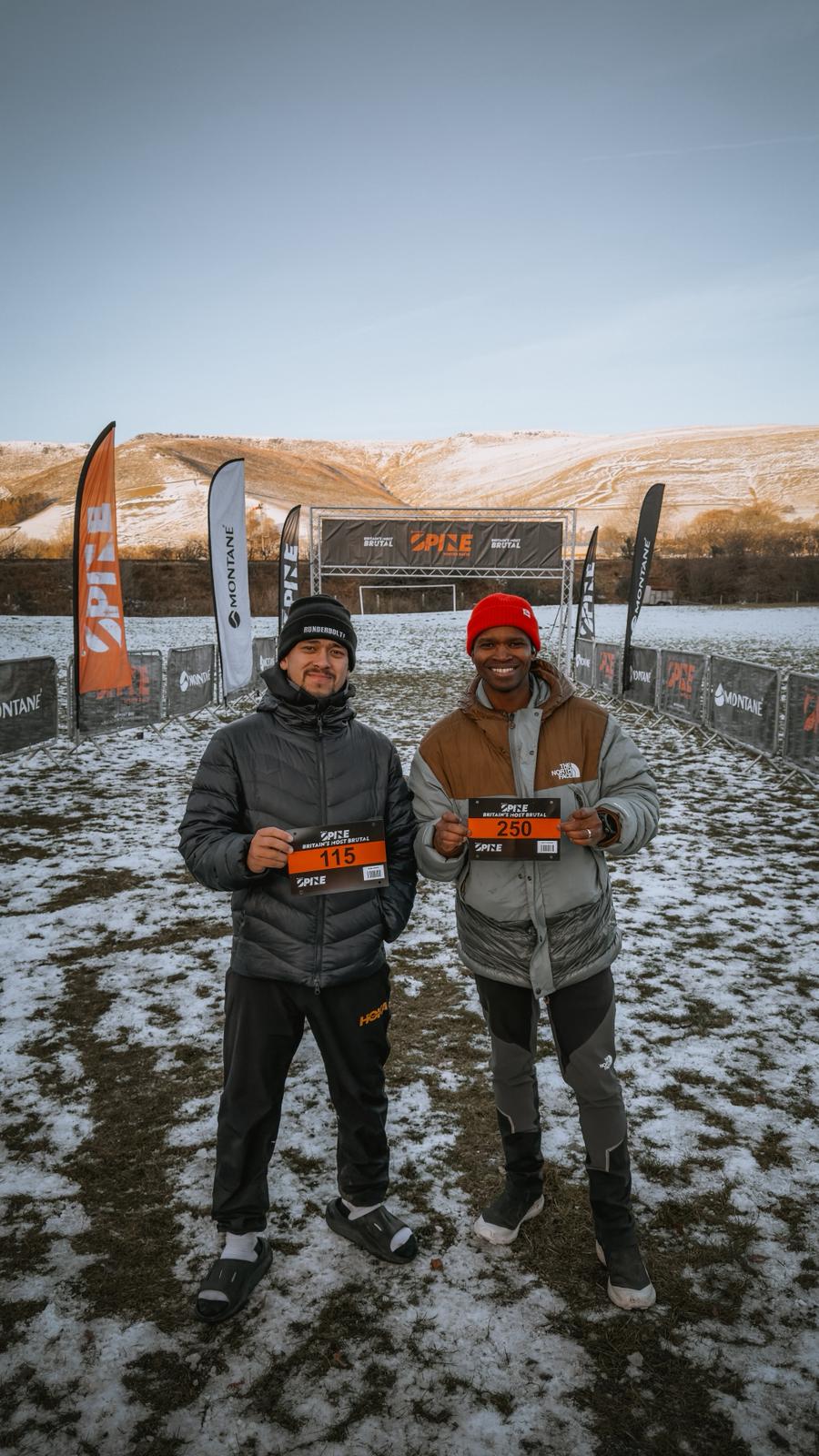
Over the past five years Camino Ultra has supported athletes taking part in all of the various distances of our beloved Winter version of the Spine.
268 Miles along the intrepid Pennine Way.
This year felt a little different.
There appears to be more eyes on this one than ever before. One of our close friends Sarah Porter had to deal with 'beheading death threats' during her Challenger South attempt.
Eugeni who was taking part in his 13th Spine and led for most of the first four days was another competitor to be taken off the course by the event team and in doing so meant he has only finished twice in thirteen years.
The extremity of this race is not in question. Camino often shares blogs of athletes who have finished and sometimes won the best ultramarathons on the planet.
However here we have two updates and two DNFs.
Anson and Ruden are two friends at Camino who have been with us since the very beginning. They have both been up to the Spine event to complete some of the shorter distance events before being on the start line for this years 2026 Full Winter Spine. They were heroes in our hearts by just being on the (severly cold and wet) start line in Edale.
We are truly grateful to them both for sharing some reflections with us so that we can all learn some more best advice if we were to ever consider doing a Spine event - which we ALL do - dont we xx
ANSON:

‘Britain’s most brutal’ ultramarathon lives up to its tag-line
I’m not sure what more there is to say about the Spine Race that has not already
been said by others. It is truly one of a kind, both in terms of distance and difficulty.
268 miles along the Pennine Way with over 10,000 metres of altitude is not your
usual ultramarathon. It is an endurance race where runners need to be able to adapt
to everything that the British weather can throw at them, while being largely self-
reliant, carrying most of their own food and water supplies on top of a
comprehensive mandatory kit that is compulsory to carry for the whole race. And I
have no doubt that every single one of 150+ runners at the start line on the morning
of Sunday 11 th had the belief that they were going to finish this epic race with the
allotted 168h, or 7 days.
Unfortunately, my race was short, and I pulled out after only 32hours, covering only
70 miles. Here’s the anatomy of my 2026 Spine Race DNF…
We knew conditions on this year’s winter Spine were going to be particularly
challenging when Storm Goretti careered across western Europe a few days before,
leading to warnings of life-threatening gusts of winds and snowstorms for much of
southern, western and central England, including the Peak District, where the Spine
Race starts. Storm Goretti was called a multi-hazard event. But on the morning of
the race, Goretti was behind us, and conditions seemed ideal actually – cold and
crisp with only a smattering of snow in Edale.
The infamous kit check had gone smoothly the day before and now drop bag and
tracker fitting was finished quickly and we were all milling around near the start line.
There were quite a few media people around taking photographs and doing short
interviews with runners before the start of the race.
And then we were off. A gentle trek onto the Pennine Way, a short steep climb up
Jacob’s Ladder and then oh my, we encountered almost immediately on the edge of
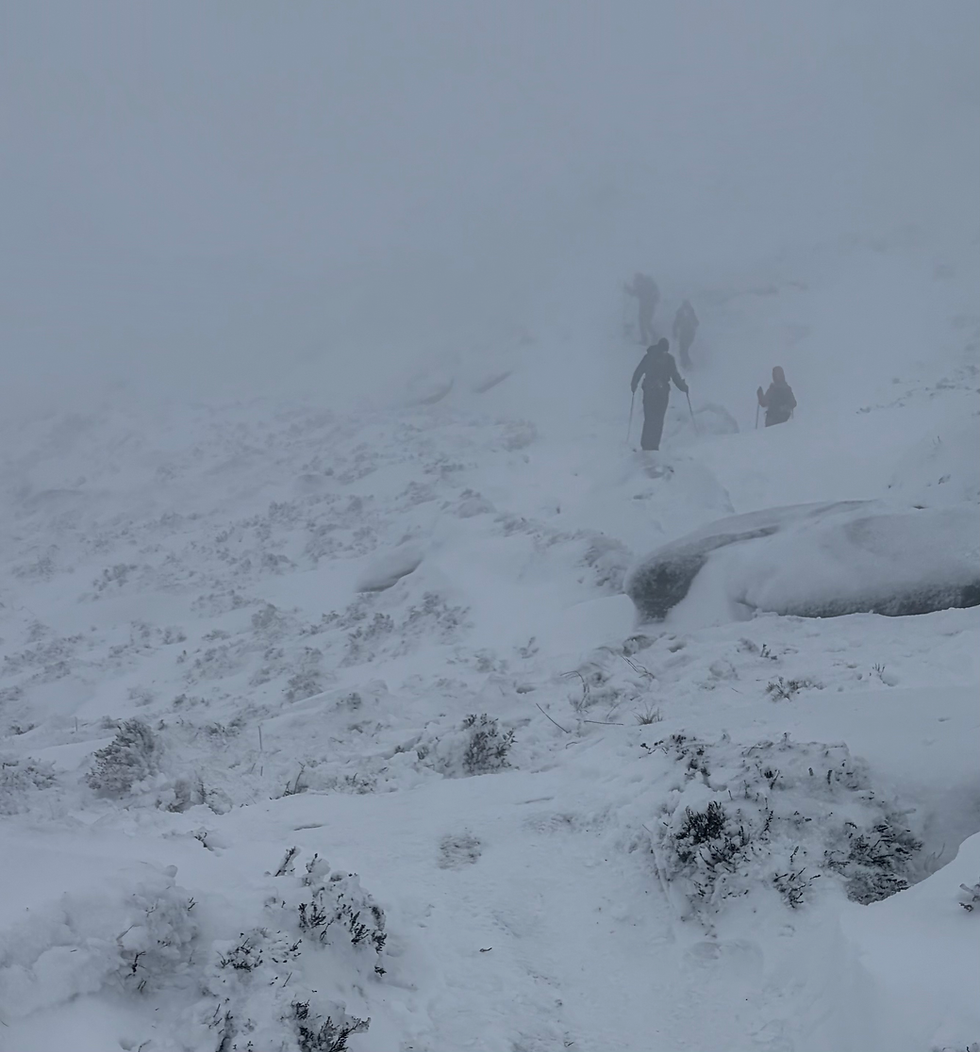
Kinder Scout, very challenging conditions that took everyone by surprise. Deep snow
from Goretti made underfoot slow-going but it was the strength of the south-westerly
winds that brought havoc, with gusts that must have been more than 60 mph. I’ve
personally never ran in such strong winds before – I was literally blown off my feet
twice, and at one point several of us were on our hands and knees crawling along
the route as the wind was too strong to stand. Other runners made their way arm in
arm. Pinned numbers on bags were being ripped off right in front of your eyes, and
the effort to get through this one relatively small section of 3-5km was immense.
But I loved it! I love running when routes are technical, I love running when
conditions are cold, and the start of the Spine brought both these to the fore. For me,
my main concern was traversing Torside Clough and Oaken Clough / Laddow
Rocks, which on my recce hikes were scary in summer, and I didn’t want to be
crossing these in the dark in icy, windy conditions! After having fallen on my arse
already on the ice, the Kahtoola microspikes were straight on before I tackled these
sections, and they stayed on until Hebden Hey.
After passing Torside Clough we were greeted by the Glossop MRT (Mountain
Rescue Team) station serving teas and coffees and just checking, I think, that
everyone was OK. There I met Val who was volunteering but who I was at
Manchester University with back in the early 1990s, and I don’t think we’d seen each
other since that time. So that was a definite highlight!

After Goretti came the thaw, but that meant that the Pennine Way was extremely
hazardous; melting water lay on top of ice on the slaps and the trackways, so you
had to be super careful of how you ran. The route up onto Black Hill had several
rivers in spate from melting snow, and I know that a few people had slipped and
fallen in as the best crossings were not obvious. Although the rest of my race was
relatively uneventful it was still hard going. I think without realising it, the effort was
quickly draining my energy stores.
Also I knew I wasn’t eating properly, and I was relying too much on gels and
chocolate rather than ‘proper’ food. By the time I reached the oasis that is Nicky’s
Van 33 miles in, I was already in calorie deficit. But I had pre-ordered a bacon roll
thinking this would solve my problems and of course it didn’t, as I wasn’t able to eat
that either. You see I have a condition called xerostomia (or dry mouth), a side-effect
of intensive radiation therapy for head and neck cancer back in 2020. Upshot is that I
no longer produce much saliva, which means that eating any dry food during races is
challenging at the best of times. My mouth was now in a continually dry state and
very sore and sensitive, so eating the solid food I was carrying was almost an
impossibility.
It’s weird though. I’d planned my nutrition so carefully for this race – I’ve done many
ultras where I’ve been able to adapt, even on the 150 miles of Spine’s Challenger
North a couple of years ago that took me just over 80 hours. But this time it just
didn’t work.
To be honest, I’m not able to pinpoint exactly where the wheels came off my Spine
adventure, but I do know that when I couldn’t eat anything at Nicky’s, deep-down I
started to fret that things were not going according to plan. By now I’d been racing
for just over 13h and had probably only taken in about 1500 calories. Hebden Hey
(the first checkpoint) was “only” another 13miles away and although I knew that I’d
be chasing the cut-off time, at least I’d get some hot food down me. But soon after
Nicky’s, I started to develop painful neck spasms every time I went to take a drink of
water from a soft flask on my backpack, or even if I tried to get something out of my
Geeky-Hiker chest pack. These spasms are caused by fibrosis or scarring of soft
tissues, again related to radiation treatment 5 years earlier.
Normally I might get one spasm a day, but now I was having one every half hour, and this caused me a lot of distress.
By the time I got to Checkpoint 1 (CP1) Hebden Hey at 02:38 on Monday morning,
I’d been running for over 18 ½ hours to reach 46 miles (74km). I ate some pasta, had
a rest (but couldn’t sleep) for an hour, ate some rice pudding then set out again. But
things were still not right. My speed had dropped and in places where I should have
been running, I wasn’t able to due to lack of energy. My faffing went to defcon 5 by
Walshaw Dean Reservoirs.
Then the horizontal rain and sleet really set in, and I got cold and wet and I knew
deep down my race was over. You could only stay at the next checkpoint (CP1.5,
Malham Tarn) for 30mins (although hot water was available for a drink or a pot-
noodle). However, this was 38 miles from Hebden Hey, and my ETA was about 2am
on Tuesday morning. And then there was another 26 miles to CP2 at Hawes, where
more food and a bed would be available. My motivation for the race was gone; I
didn’t believe deep down that I could make it in the psychological state I was in.

So many emotions were going through me at this stage. I called my partner David
several times, depressed and angry with myself; how could I have gotten into this
funk so early on. Crucially for me, I was no longer enjoying myself, and if there is
ever an off-switch for me, that is it. Don’t get me wrong, I can be going through the
most treacherous difficult conditions and still find it fun, but I felt the soul had gone
out of my race.
Via David I got some great advice from Camino Ultra’s David Bone, and I pivoted.
Not everything need be about the race, and I needed to find the joy elsewhere. This
was easy – the hiking recces that David and I did together over the summer were
wonderful. I was so privileged to be able to be taking part in this race, when many
others could not. I was traversing some of England’s wildest places.
I decided that I was no longer going to “race” the Spine, but I was going to have a
bloody good hike through the night between where I was and Malham Tarn and then
possibly to Hawes, and that would be exciting in itself. It wouldn't matter if I DNFed
then, as I was there for the experience of being out on the Pennines having an
adventure. My mind and enthusiasm were back on track!
But then within a few hours, I got absolutely soaked in the now almost permanent
wind and rain. I don’t know how, but the rain and sleet got through my waterproofs
and I was starting to shiver on Thornton Moor. I pivoted again, and made the
decision that I didn’t think it would be sensible if I carried on up through Malham
Cove and Fountains Fell etc. I didn’t trust that I would be physically or mentally able
to complete those, and I definitely didn’t want to have mountain rescue to be called
out to help me all for the sake of ‘pushing on’. So I decided that I would DNF when I
met the next Spine Safety Team at Gargrave about 6 miles away. However, there
was an SST just setting up in Thornton in Craven just a few miles on, where I
officially withdrew from the race.
------------------
The aftermath
Nothing can prepare you for the disappointment of failing to do something you’d
been planning for the past two years. It is hard. There is shame; my coach Sophie
from Queer Runnings got me to the start line, but I wasn’t able to fulfil my promise to
get to the finish line. There is anguish - there are so many ‘what ifs’ as my mind still
goes through all the decisions I made, and how it could all have turned out so
differently. I could go on.
But there are many positives to take away from this race as well. The Spine Race is
special.
I got to meet so many people on the route, each with their own stories, each facing
their own challenges and demons. Sharing those experiences is one thing I won’t
ever forget.
I got to hike with David and Llinos in my training. Hiking forms as much a component
of the Spine Race as running, and over these past 7 months I’ve got to have hiking
holidays with David, recceing the southern Pennines from Edale to Hawes. I made
new friends like Llinos Proctor on a more recent hiking weekend across Hadrian’s
Wall and the Cheviots. These still fuel me with many happy memories that I would
not otherwise have had. And I could not be more proud for Llinos who went on to
finish her Spine Race!
I got to represent runners not in the gender binary. I’ve been contacted by so many
other non-binary runners both during and after the race about how representation matters. That made me feel pride.
RUDEN:

I first got into the Spine world after being inspired by my friend Sabrina Pace-Humphreys, who I saw complete the Summer Full Spine in 2022. I thought she was incredibly strong, it was impressive and inspiring to see someone achieve something so brutally hard and show others that it’s possible.
I set out with the ultimate goal of completing the Full Spine in winter, but my strategy was to level up through the distances. I first did the 108-mile Challenger South in winter 2024 and found it unbelievably hard especially the hallucinations on the never-ending Cam High Road and the freezing conditions on Pen-y-Ghent, where my water bottles froze solid. But I finished.
In 2025, I did the Winter North Challenger, officially 160 miles, but somehow ended up clocking 176 miles. Again, I found it insanely tough and felt like I was in another world of hallucinations and pain after snapping my hip flexor with 50 miles still to go. Somehow, I still finished.
Then I did the Summer Spine Sprint South with Rabina, and it was a breath of fresh air to tackle a shorter distance in better conditions while still getting that Spine excitement. After that, it was time to attempt the Full.
I had been focusing on my hip recovery for the whole year, going to the gym more and refining my kit and nutrition. Thank you to Yam brother, our Boltyard reigning champion, who wanted me to eat 250+ waffles, I don’t think I had the budget to turn into a waffle, but I certainly made some changes. And thank you to Dave from Camino for the love, support, and for keeping me fuelled.
You can never be fully prepared for a 268-mile race in deadly conditions, but I felt more prepared than I had been in previous years especially compared to Challenger South, when Camino Paula helped me condense a corridor full of big black sacks of gear into something that actually passed kit check.

I had the best few days of kit prep, kit shopping, chicken feeding, and adventuring with Zukie. He helped me be ruthless and get my kit weight down drastically, which I was incredibly grateful for during the race compared to last year, when I was probably carrying double the weight.
We had some funny highlights during those few days, from Zukie getting excited about my Lamborghini toilet scoop that weighs only 16 grams (his weighed 80+ grams), so he immediately went on Amazon to get one and was way too excited about it. We also went on a last-minute search for a pair of hair clippers and, in the process, got the car stuck on ice on a hill, only to end up going to a barber shop instead.

On the morning of the race, my drop bag was 22.6 kg, so I had to take it back to the car to ruthlessly get rid of more unnecessary items and finally got it down to 19 kg. Then my number one supporters, Nesha and Lia from Nuneaton Bolts, had driven all that way early in the morning to see us off and deliver some life-changing mini Wai Wai noodle packets, thank you for coming! They have been supporting my spine journey for years and always go above and beyond to come and support and give me the energy I need.

In the lead-up, I felt like my hip or stomach was going to play up and be an issue. I started the race slow, as planned. Not too far into the race, I slipped on a hidden ice sheet on a stone, which was a warning to put my ice spikes on. By that time, I was at the back of the pack and playing catch-up, but I was also trying to reassure myself that it was a long journey with lots of time.
As we ascended the first section, it was wild. Everything around was thick snow, white, and there was no visibility. Snow, rain, and extreme gale-force winds were blowing sideways into our faces. I couldn’t breathe, I was getting blown everywhere, and I had to face the other way while moving forward. I decided to take shelter behind a big rock for five minutes just to take a moment and make sure all my kit was in order before moving forward and battling the rest of the section.
At one point, the wind was so powerful that I was blown up the hill and didn’t even need to use strength to lift my legs. It felt like I was abseiling up a wall, just positioning my feet. I watched my race bib fly away and disappear, getting eaten up by the storm.
As I was descending back down, I stepped on what I thought was a rock covered in snow, but it was a ditch hidden by a layer of snow. I fell straight into it sideways and smashed my hip on a rock on the side. Luckily, it was just bruised and didn’t affect my ability to keep moving forward.

By the time I got to Torside Reservoir, my ice spikes had been ripped to pieces. The rubber had snapped, parts of the metal chains were missing, and the chunky metal spikes in the middle had inverted, piercing through my shoe and digging into my foot.
There was a diversion around Dean’s Clough, and luckily I had downloaded the diversion GPX as it wasn’t obvious which turns to take. At this point, I was running with two people, and I had to lend my head torch to one of them when he checked his pockets and said, “Oh no, it must have dropped out.” We carried on until the A635, then he suddenly said he was going to stop, drop out, and get a lift. I heard Spine volunteers asking for his race number but didn’t take much notice, shook his hand, and kept moving. However, there is no trace of him being in the race hopefully we weren’t hallucinating him the whole time. It was way too early in the race for the usual invisible (hallucinated) friends to join us.
The last section to get to the Hebden checkpoint felt never-ending. I felt like I was so close for hours just a bit further, a bit further and then you still have to go down the steep, muddy hill to reach the checkpoint.
I made sure not to faff as much as I did two years ago at this checkpoint. I put all my devices on charge, put my clothes to dry next to the fire, washed and changed my base layers, brushed my teeth, and then had some food. Even though I focused on the essential tasks, this still took nearly two hours, as time flies when you’re in Spine faff mode.
I then met Anson from Camino, and it was so great to see a friendly, familiar face. We agreed to leave together after he sourced a missing rear red light for his pack. As we climbed back up the steep, muddy hill, his pace was clearly way too fast for me, so he plodded on ahead while I tried to re-engage my legs into grind mode.

Around the reservoirs, I was sleep-running and walking every few strides, sometimes just pausing and sleeping while standing up. I must have looked odd from behind. That’s when Jaco caught up with me and gave me a Pro Plus and a chat. His energy was exactly what I needed, so I used that, along with the daylight, to push up a gear. We were running the flats and downhills and trudging up the hills.
I teamed up with Jaco from South Africa and Juan for a while, and we passed my favourite Highland cows that I remember from doing the south route. There were fewer of them this time, but they were still a joy to see with the sunset and chickens. I was awake and moving with better pace, running the flats and downhills.
But then something internal in my hip maybe sciatic nerve pain hit me suddenly and sharply. At another point, I twisted my ankle and screamed out. In the moment, it felt like I had fully sprained it and that it was going to swell up and take me out of the race. But I think over the years my ankles have developed the ability to withstand these incidents, and I managed to run it off.

We stopped at the pub in Lothersdale and ordered hot, chunky chips with salt, vinegar, and ketchup. It was life-changing, and there were many other Spine runners in there too.
We carried on and started running along the canals for a long time together. The red lights disappeared into the distance as I began slowing down from sleep deprivation. I was hallucinating giant cows, demon faces, and big clay sculptures of ancient beings.
In the distance, I saw a red light, a white light, and some hi-vis lines. That was normal, it was a participant but as I got closer, they weren’t moving forward. At first, I thought they were hugging a loved one who had come to see them mid-course. Then, as I got closer, there was no loved one, but the lights were all dancing and moving like an LED hip-hop dance routine. This lasted for about 5–10 minutes, and I was genuinely trying to understand why this participant had decided to stop moving forward to perform a dance routine on the Pennine Way.
Finally, I got face to face with him and realised he was chest-deep in mud and sludge. The whole time I thought he was dancing, he was actually struggling to get out of a bog he had fallen into.
On this section, my stomach started to feel weird and my throat began to burn with acid. I reached the Malham pub and ordered an orange juice. A fellow participant who was about to leave invited me to sit next to the warm radiator. I put my bivvy bag into a cushion shape on the table and laid my head down to try to get some kind of nap.
I think the rare sense of calm and comfort from the warm pub exposed the reality of how sleep-deprived and sick I was. I rushed to the toilet and immediately began to puke. It was all yellow liquid, and then blood, probably from the pressure of being sick. My throat felt like it was closing up and burning even more afterward, and it took some time to get my breath back. I unlocked the toilet door in case I passed out and needed help.
Once I sat back in my comfortable radiator seat, I felt a bit better sometimes you feel relief after puking the problem out of your system. After anxiously ChatGPT-ing how dangerous my symptoms were, I decided to continue and teamed up with six other runners who were leaving the pub at the same time.
We climbed the steep stones of Malham Cove to reach the Malham Tarn monitoring point. As I entered, it was clear I had lost a lot of energy from not being able to keep food and liquids down. I was swaying and shoulder-barged into a parked car as I entered the building. The volunteers asked if I was okay and said I looked very wobbly and started to look concerned.
We stopped for half an hour. I had a hot chocolate and vegetable soup.
At this point, I knew I wasn’t really in the right state to push on into the cold night, with at least another 26 miles until the next proper checkpoint. Despite unconsciously feeling like it might not be my race this year, and thinking maybe I should call it a day, I also knew this is what I signed up for. These are the mental battles you have to face, and you always try to find a way to go one bit further.
And I did. I went out with the others. They weren’t moving particularly fast, but to me it felt like they were sprinting. I could tell I had slowed down substantially and was lacking energy. I was still sleep-walking side to side and waking myself up to redirect.
After a few kilometres, the sickness returned and became really painful and uncomfortable. I told the others to go ahead without me and said I’d walk back to the checkpoint. I started doing that but had no idea where I was going, and visibility was poor because of the rain. I turned right through a gate that was the wrong way and had to climb back up to find the correct path.
I was delirious, sleep-deprived, in pain, vulnerable, and alone in the wild until I saw a head torch coming toward me. I thought it was Spine staff or a volunteer coming to find me, but instead it was Graeme (121), who became my hero. I told him my situation, and without hesitation or concern for his own race, he insisted on walking me back to safety. Even after I told him to continue so it wouldn’t jeopardise his race, he stayed with me and never once made me feel like a burden. He said he had plenty of time. Thank you, Graeme.
I got back to the Malham Tarn monitoring point and saw the medics. They did their checks, made phone calls, and discussed things among the volunteers and Spine runners in the room. They advised me not to continue. I dragged out the process, not wanting to give up, and asked to close my eyes for a bit before deciding. They reminded me I still had another 200 miles to go while feeling extremely sick.
At that point, as hard as it was, I decided to pull out. After 149 km and 40+ hours, I knew that pushing further with the mix of sleep deprivation and sickness could have been fatal.
I was dropped to Hawes, had a life-changing shower and sleep, then met Kingsley and lent him some kit after his gloves flew off, his Yaktrax snapped, and he said his glasses were going to crack. I then kindly got a lift from French participants to Garsdale station, then on to Leeds, London, and finally back home to Kent.

Overall, it was a great experience, apart from being so sick. I learned even more and felt like I pushed my body close to its limits and made the right call. I’m frustrated that I feel like I defeated myself, but I can learn from these lessons and come back more prepared and better practised with my nutrition and sleep strategy. Thank you to Bolts gang who had planned and booked the logistics to come up and see me at the finish line in Kirk Yetholm, the finish line party will have to wait…

I’m proud that the Spine conditions didn’t defeat me. Despite the crazy weather this year, I rarely felt cold and feel I dealt well with all the challenging elements that came my way.
The journey continues…
Thank you.


Comments