
Summer Spine Stories

Over the past few years more and more Caminos have been experiencing all the new distances and events being offered by the Montane Spine team.
There was a time when most of our Camino community were exclusively signing up to experience the Winter Spine more and more of them have been taking on the Summer version.
For the first time the Spine organisers offered five open events - the Sprint and the Challenger series now both have a North and South version to join the full 268 mile Spine.
Three Camino Superstars were dipping (literally) their trail shoes into the Spine world for the first time. Aaron was taking on the Sprint North (with many of his Runderbolt family), Thai the challenge of Sprint South and Derrick following up his bumper ultramarathon year and post Marathon Des Sables with the Challenger South.
Over to these there Camino Legends to share more and hopefully make more Caminos consider taking on one of these wonderful Spine events in the future.
We have a wonderful group of athletes taking part in Winter 2027 and will be hosting some recces together in Autumn.
If you would like to discuss the Spine as a potential event to be coached for them do get in touch with us - info@caminoultra.com
AARON:

The Montane Summer Spine Sprint North in one word is ‘unforgiving’.
There is nothing short about 70km+ across boggy mountainous terrain with 2300m+ elevation gain. Throw in all my mandatory kit, food and water that I would have to carry from start to finish, as an ultra runner with cerebral palsy, I knew this was going to be a huge challenge. I was about to be the first known person with cerebral palsy to do a Spine Race event.

The defining factor of this race is total self-sufficiency. The race started at 12pm. There are no aid stations and zero checkpoints. No markings to show you the way. Just me, a GPX file on my watch and the entirety of my mandatory kit; including a map and compass if the navigation on my watch fails.
My pack weighed a solid 8kg. The weight shifts my centre of gravity. When factoring in cerebral palsy, managing fatigue, footing and stability become a constant calculation. Every step required total intention.
My strategy was simple: one step in front of the other. Stay efficient on the flats, power through the climbs, and utilise any runnable descents.

In ultras, you learn that every low point eases if you just keep moving. There were more highs than lows and I feel incredible that my body complied throughout.
At about 38km in, I buddied up with a man named Wayne Appleton. We stuck together through the night. There is a beauty in the silence of two strangers plodding along… deep in the pain cave… knowing that you understand what each other is going through.

As I got into Kirk Yetholm and approached the Border Hotel, it was a massive relief. But more than anything it was validation. Completing a grueling, self-sufficient ultra as an athlete with cerebral palsy proved that the boundaries we think exist are there to be pushed.
I am so proud to be part of the Camino Ultra community. Thank you for tracking along.
I am now seen as the first known person with cerebral palsy to finish a Spine Race event…
I have cerebral palsy, cerebral palsy DOES NOT have me!
THAI CASTRO:

Spine Race - Sprint South 2026
Let’s start from the beginning. My name is Thainan, most people call me Thai. I’m from Brazil and living in London since 2023. And like many others I started to run during Pandemics, somewhere around 2020 and 2021.
Long story short, in 2011 I was playing with a tight rope at the beach in Rio and I fell from a 4m high and broke 3 vertebrae in my neck. At the moment everything went numb. Got rescued, went to hospital, surgeries, all the process and the day after the doctors came to me and said everything was "fixed" but as he experienced before this kind of thing is almost irreversible and I probably would never get on my feet again. The prognosis was that I was tetraplegic, and maybe could move my arms in the future depending on the physios and other treatments and care I’d have after. After a year or so I could stand on my feet again, take some walks but running was completely out of reach. I didn't have the muscles, the balance, the movements, anything. And, again, the docs said I had to avoid impact on my legs, on my back. Avoid running.
And so I did, for almost 10 years.

During Pandemics, when the lockdown got more flexible I started to go out again, early in the morning, and do some walks around my block or at the beach. One day I tried to jog. It took 10m to start to hurt. And I walked again. And the next day I went for 1min jog between my walks. And slowly I rediscovered running in a different way. In a way my body could handle. And I fell in love again with the movement.Since then I’ve been running regularly, humbly increasing my mileage (half marathons were A BIG THING), trying some stuff... One day I just signed in for a 50k with a friend.(but it’s another story…)
And then I moved to London. And started to discover the city by walking and running around. Met some people, made some friends. I heard about some amazing people doing amazing stuff around here, met some of these people and as a twist of fate I met Camino Ultra.

And this story starts here. Three years ago when I arrived in London. It was when I heard about The Spine Race. “ The Britain’s most brutal” race. For those who have never heard of it, the Spine happens through the Pennine Way, going from Edale to the Scottish border, and basically has three different distances: Sprint (43 miles), Challenge (107miles) and Full Spine(265 miles). And has a version in the summer and in the winter.I remember hearing about the Spine in the winter of ‘23 when I got to London.

The distances sounded impossible, almost unimaginable for me. The race also has the sparkle of being self-sufficient. You have to carry all the mandatory kit, food and water all the time between the checkpoints, which are around 75km between each other. It’s a bag that easily reaches 6 to 8kg.The navigation is only through a map or GPX on your watch or device. No route marks. And on the top of the cake the Peak District area is known for having one of the most unstable weather in the UK, with mountainous and big exposed areas.
The name “SPINE” touched me from the beginning. I broke my neck, my spine. There was something there for me.Last year I spent some time in front of the computer in a July morning, waiting for 10AM, with all I needed to try to get into the race: a cup of coffee and a cup of courage. And I got a place on the Sprint, between some sips of both mugs. Never ran that distance, never ran carrying that weight on a bag. And I had 1 year to prepare myself.The start is on 13 of June - 12AM. A week after my birthday. 36 years. To put my shoes on, grab my bag and get to the start line was my gift for this year. What would happen after I crossed that line would be my gift for the future me.
My main objective is to get alive in the end, enjoy the experience. Not aiming for a specific time or anything in particular. I just had 18h before the official cut off to get to Hebden Bridge, 74km up north from Edale.And the race is on. I was feeling comfortable, got to the top of Jacob’s Ladder feeling good and started to move through the rocks.

Due to my injury I can’t move fast through technical terrain and I’ve heard the first 40k were super technical haha. After 10k another ladder, this time going down. I went super cautious and right in front of me another participant just fell and rolled a good 20m down. She got injured, we helped her and she could go on. Just after that I met the bogs. I started to run again through the rocky path, feeling that I could run a bit for a while but put my foot in the wrong place. Then I was with my whole leg inside a bog, knee bleeding, legs hurting. Couldn’t even wake up again for around 5 min. Though it was the end for me, maybe I had to drop off the race. Took off my poles and started to walk. Deep breath, got some food and let’s go again. Then at some point it all became a blurry memory. The hours just passed like minutes. I could run some times, I walked nonstop.
Three hours passed like 30 minutes.Three more hours in, some reservoirs, rocks, bogs,rain, wind, everything the Peak District can offer, and more 2 hours and then the night.Lights on, around 11PM and I started to see Nicky’s food bar. I think it was the first time I stopped to sit down a bit. Got a burger, put on some warm clothes. It was getting cold with all the wind. Got a coffee before I left and on the other side of that cozy container my body started to refuse to move again. Everything was stiff but I could walk slowly. After a few minutes I was moving forward. It was dark, I was alone.
All I had was a 5meter radius light around me from my headtorch. Everything else was a mystery. Was empty, black. I lived on that spotlight for a few more hours, following the path, following a fox that I discovered was a hallucination at some point. Took a wrong turn and walked on a parallel (and waaay more difficult than the one I had to be) road for almost 1km and got back on track. My fault, should have listened to the fox.
And I saw that big silhouette of Stoodley Pike unveiling himself with the first light of the day on the horizon. I had a visual point to reach again. I got to its foot and saw the sky turning red, then yellow and slightly blue. It was almost day. And it was all downhill from there.I just kept pushing, my body started to wake up again with the new day. I could run a bit, or it's just me being silly to call that a run. But I was moving. And I saw the city, crossed the bridge, crossed the main street that still sleeps, hiked the last meters uphill Birchcliffe Rd. (oooff) and got into the last 6 steps before the finish line.

Almost 17h moving. Never been in a race that long. Never been that far on my feet. A part of me didn’t want to go up those steps and finish the day. And I realized that it was only the beginning.
Some say running is a solo sport. I brought so many people with me in my heart, all I can say is a team effort. Thank you Camino Ultra for being a big part of this journey.
DERRICK TATE:

The Spine Challenger South: Sleep deprivation and some running on the Pennine Way
The alarm jolted me awake. I’d set it only 15 minutes earlier for a “trail nap” on the bench in Gargrave bus shelter, a classic Spine sleeping spot. It was Sunday lunchtime, warm and sunny, and after 28 hours I had completed 68 miles of the race. I felt refreshed and strong, but the lack of sleep was beginning to catch up with me. I’d tried to sleep for two hours at Check Point 1 the night before and barely managed any; around 4am I’d lain down and slept at the side of the trail until the cold woke me up after 15 minutes, just enough to keep me going. My nap in the bus shelter would turn out to be my last sleep until I finished at 5am on Monday and the sleep demons would torture me through the night to come. At the nearby Co-op I sat outside with 5 other runners and ate some food before some of us set off together. Of the 6 only 3 of us would make the finish.
Why this race
In ultra running, the Spine is a classic. The UK’s most brutal race. The full Winter Spine in particular, 268 miles on the Pennine Way, the Peak District to Scotland in January, looms on the horizon as a challenge that someday must be faced. I didn’t feel ready for it in winter 2027. I wanted to recce part of the course and see what the Spine was like first. So I signed up for the Summer Challenger South, an opportunity to do the first half of the course in better conditions and experience what the event is all about. The Summer Challenger South has a reputation as a tough race in its own right. Summer is a bit of a misnomer: as I was to discover it can be wet, windy and very cold on the hills even in June.
The course
The Challenger South is 108 miles long with a 60 hour cut-off. Elevation is 5,451 m (17,884 ft). There is only one full checkpoint at Hebden Hey, 44 miles into the race, where you can stay for up to 4 hours. As well as access to your drop bag, you can get hot food, a shower and a bed to sleep in. There is also a monitoring point at Malham Tarn, where water, snacks and hot drinks are available, but dwell time here is only 30 minutes. Apart from these, food and water are available in other places, including the iconic Nicky’s café, a Co-op, an honesty tuck shop on a farm and the pub in Horton-in-Ribblesdale. Runners are encouraged to carry a water filter to use when drinking from streams. I carried one but thankfully never had to use it.
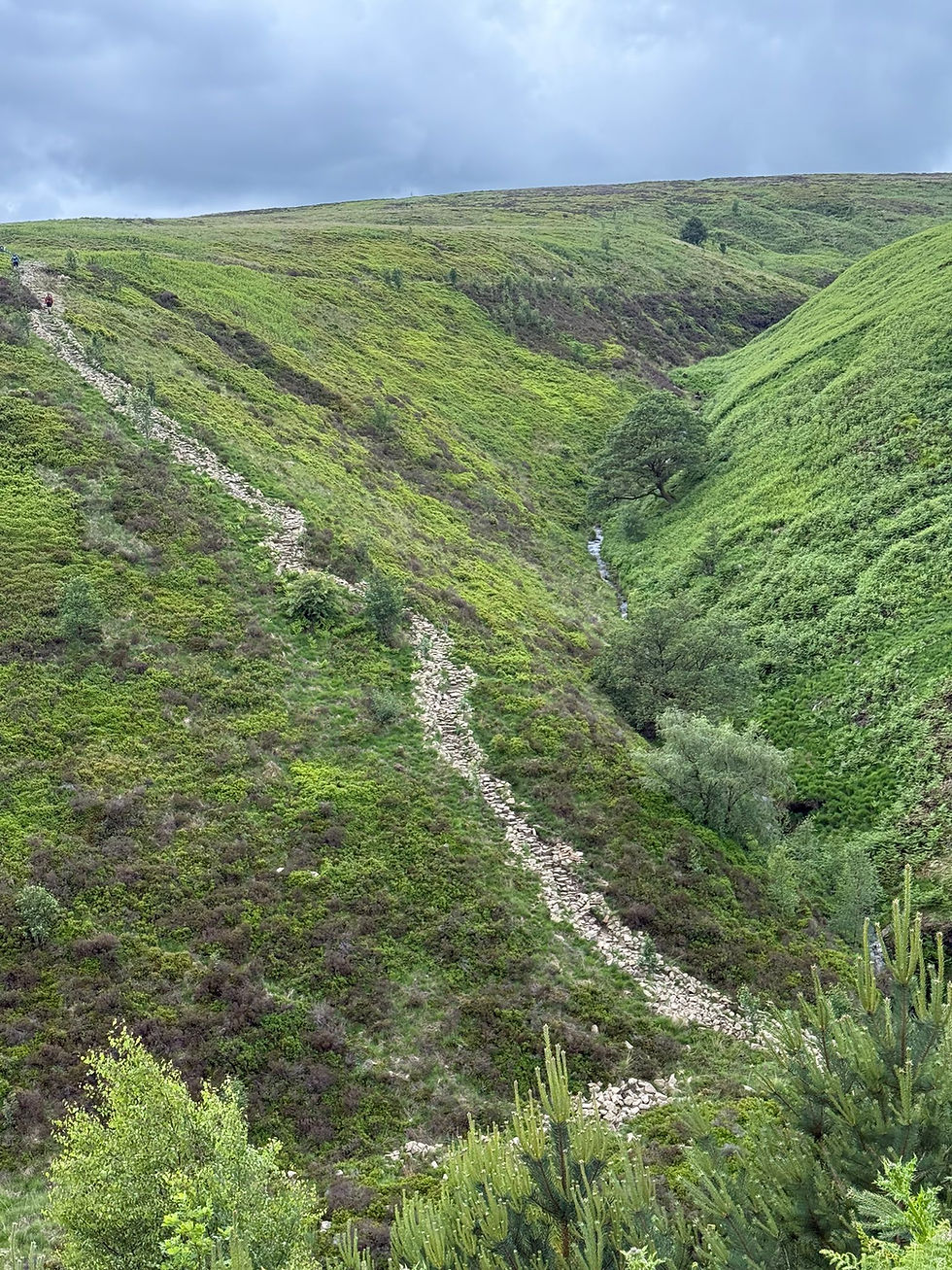
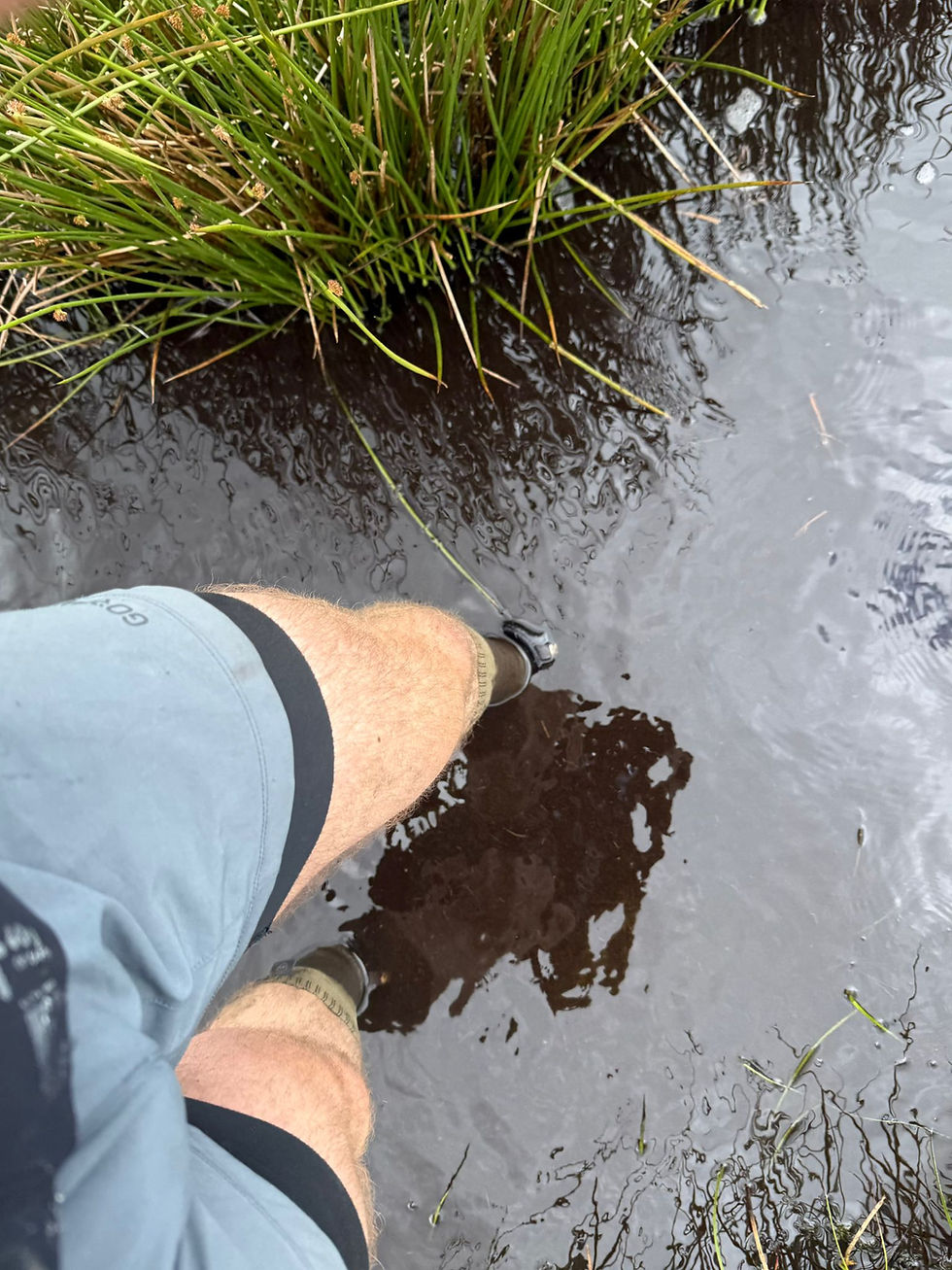
The terrain is very mixed. You start on a short road section, and there are several other short road sections. To reduce erosion, large sections of the Pennine Way have been paved with stone flags reclaimed from the floors of demolished cotton and woollen mills. Although hard underfoot, I enjoyed running on them. There are bogs, lots of bogs. In summer at least, they were mostly ankle deep, rather than knee or waist deep as they can be in winter. Many sections go through farmers’ fields, complete with cows, sheep and ponies. There is even a section on the Leeds and Liverpool Canal towpath. Most of the rest is typical rough, stony hill trail. There are some becks to be crossed and many stiles and gates. Lots of the stiles have small sprung gates in them, which I hated as they were difficult to get through with poles and a rucksack.
Preparation
I had not specifically trained for this race. I had trained hard for the Marathon des Sables at the beginning of April. After recovering from that, I had run 50km at the London 100 in May before having two wisdom teeth surgically removed. When I recovered from that, I only had one week’s training, then one week’s taper before the race. I hoped my MDS fitness would see me through. I wasn’t targeting a particular time; I was underprepared and was going into the race with no goals other than to experience the Spine and to enjoy and finish the race.
The race has an extensive kit list and kit is inspected both at registration and before leaving the checkpoint. It’s the usual stuff for a 100-mile race, but for a winter rather than a summer one. A trowel for burying poo is one of the more unusual additions. Runners may also be asked to prove they can orientate a map and compass and both find and provide a grid reference (remember, along the corridor then up the stairs). I was able to use the kit I had amassed for the Arc of Attrition and MDS with a few additional purchases such as a waterproof bivvy bag and a chest pod.
Edale to Hebden Bridge
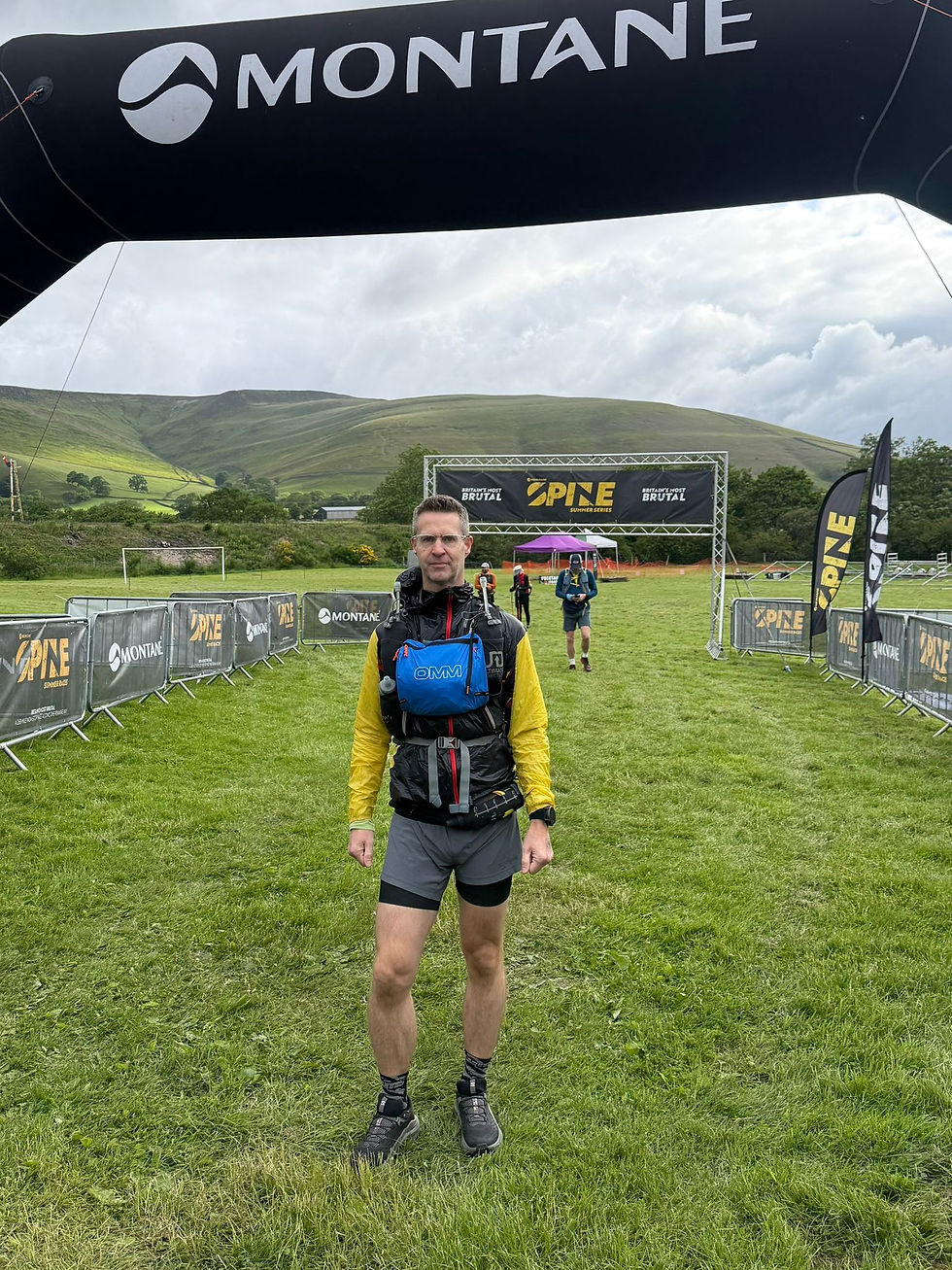
At the start of the race on Saturday morning, it was just beginning to drizzle, and the atmosphere was a bit subdued, tense almost. I think the enormity of what was ahead of us was sinking in. The field size was relatively small compared to UTMB or even Centurion races: just 150 starters.
Edale to Hebden Bridge had some amazing scenery, but it also rained for most of the first few hours. After a great send-off through Edale, Jacob’s Ladder is just 3 miles in. 300m straight up on rough, uneven stone steps to the Kinder Scout plateau. The landscape here was boggy and exposed to the now increasingly wet weather as we ran along to Snake Pass, then through bogs, climbs and descents. About 4 hours in, there was an aid point operated by Oldham Mountain Rescue. As I approached, a woman called my name. It was Anita, an old friend I hadn’t seen in over 5 years. She’d spotted my Instagram post that morning and come along to support me. A lovely surprise, and a big lift.
The weather dried up, and I progressed up Black Hill and along the moors before descending to Nicky’s café about 26 miles in. It’s a shipping container in a car park but a very welcome sight. Fixed-price £15 menu, as much of anything as you want. I managed a hot dog, chips, a Snickers bar and 3 cups of flat Coke before getting on my way again after a lovely sit-down in the warmth for 15 minutes.
After crossing a footbridge over the M62, the trail went along Blackstone Edge and onto Stoodley Pike before descending to the Calder Valley. Eventually, after some very overgrown and difficult trail, I arrived at Check Point 1, Hebden Hey, at 10.30pm.
Check Point 1 Hebden Hey
I felt reasonably strong at the checkpoint, still not even half way and 17 hours in. I sorted my kit, had some food and, although I wasn’t sleepy, went into the dormitory to try to sleep for two hours. I struggled to drop off, but I managed some sleep before getting up, having a coffee, brushing my teeth and heading out again into the night.
Through the night to Gargrave
I kept going the rest of the night on my own. Just head down and keep plodding on. Running at times, hiking at others. Towards dawn, I started to feel really sleepy. I lay down beside a wall on the track, rucksack still on, and slept for around 15 minutes before the cold woke me up. By daybreak, I had caught up with some other runners and we passed Top Withens, the inspiration for Wuthering Heights. We continued through some very wet and boggy fields before climbing again, crossing moors and pushing on through the Aire Gap, out of the southern Pennines with their gritstone peat bogs and into the limestone scenery of the Yorkshire Dales. The Cam Lane Tuck Shop (a shed with a fridge, kettle and honesty box; well stocked with snacks and drinks) provided a welcome late breakfast of a scotch egg, crisps, coke and snickers bar. A short, easy section along the Leeds and Liverpool Canal, then we arrived at Gargrave, mile 68, where I would take the trail nap this blog opened with.
Malham to Horton in Ribblesdale
Malham Cove was the next landmark of note. This is probably the most beautiful bit of the national park we passed through in daylight. By this point only one runner was still with me. A dramatic 80m curved limestone crag formed during the last ice age, and a popular spot for visitors on what was a beautiful Sunday afternoon. Climbing up some steep steps to the side we crossed the notoriously slippery limestone pavement and onto Malham Tarn, England’s highest lake and location of the Monitoring Point where we were able to refill water, sit down a bit and have some snacks and a cup of coffee. The runner I was with stopped here to sort his feet and I headed off for what would turn out to be a long beautiful section on my own.

Fountains Fell came next. On the way up I had had a good chat with a man who was walking from Land’s End to John o’ Groats, wild camping on route. The rocky path down was really sore on my feet, still no blisters but my feet were starting to complain at the battering they were taking. On the way to Pen-y-ghent I again felt drowsy. I lay down by the side of the road but couldn’t sleep, so after five minutes I gave up and went on my way.
The climb up Pen-y-ghent, the highest point on the Pennine Way, was a real highlight for me. I’ve always enjoyed hill walking and this was a steep climb, with some scrambling up rocks on the last push to the top. The evening views were spectacular and there wasn’t another soul in sight. It felt very peaceful. The descent was a good track paved with stone slabs which I was able to run down quickly. I was able to keep running most of the way into Horton in Ribblesdale, arriving just after darkness darkness fell. The pub here had opened its doors to Spine Racers and I enjoyed some soup and chips before heading out again at 11pm.
School boy errors
It was at this point I made some mistakes that I would regret for the rest of the night. I was in head down, just get it done mode. I hadn’t planned ahead at all. I should have stayed in the pub for a short sleep (they’d offered up some sofas), I should have drunk some coffee, I should have looked at the remaining route to understand the terrain and likely time required, I should have charged my head torch, I should have looked after my feet and I should have put some warmer clothing on. I should have applied my brain, but it didn’t even occur to me to do any of these things; I was just laser-focused on eating and getting back out and pushing on.
Cam High Road
The last 19 miles, mostly along what is known as the Cam High Road, make up one of the toughest parts of the Spine route. This section was very much the crux and low point of the race for me. It follows the line of a Roman road, dead straight in places, and very exposed to the wind and weather with no shelter. This is where I started to pay for my mistakes leaving Horton in Ribblesdale. Wind chill was 4°C and it chilled me to the bone; I realised I was still in my shorts. I stopped, put on my waterproof trousers, hat and gloves and that really helped to warm me up a bit.
I then started to get really sleepy. It’s hard to describe how you can be walking yet still falling asleep. I desperately wanted a nap, the urge to sleep overpowering, but I didn’t think I could stop to sleep. I feared hypothermia, as I was so cold. I did have a waterproof bivvy and down jacket in my bag, but in my mind they were for emergencies only, which this wasn’t, and I didn’t want the faff of getting it all out and putting it away again in the strong winds. I just soldiered on. It meant the track blurring at times, some swaying on my feet, moments of jerking awake after a micro-sleep. Hallucinations, though not the interesting kind I’d had during other races (goblins running alongside me, a silverback gorilla in a field), just rocks becoming buildings, clumps of grass turning into plastic crates, sheep into people. A pair of fast runners went speeding past me, were they real? The imaginary buildings were torture as I kept thinking I’d found a sheltered spot to sleep. I had been joined by two other runners, and we just pushed on heads down.
I was so focused on staying warm and awake that I neglected to eat and drink for several hours. I had caffeine bullets in my front pack, but in my sleep-deprived state I just didn’t think to eat them.
The finish
Eventually we branched left off this track to go along the flank of Dodd Fell and onto the final descent to Hawes. The change of terrain from a stony track to bog for some reason woke me up. A couple of miles later, as it was starting to get light, we could see the lights of Hawes. Through Hawes and further along the Pennine Way we finally came to the finish line, just after 5am, 45 hours and 11 minutes after starting. I was 57th overall, 38th in my age category. Middle of the finishers (about a third starters DNF’d). I was very happy to have finished, mostly relief that I could now stop. I had been on my feet for 12 hours longer than I had ever done before. I was too tired to feel emotional about it. I just sat down, had some food and tea. I then got two wonderful hours sleep in a tent before getting a lift to the train station. At the station some runners were already there, including two of the runners I had last seen just past Gargrave. Both had DNF’d not long after. I felt sad for them, having run with them I’d felt invested in their success, but they were in good spirits, and I enjoyed the journey back to London with them as we devoured our food from Pret a Manger.

The Spine bug
Part of why I entered was to decide whether to commit to a future full Winter Spine. There were times on the Cam High Road that I told myself there was no way I was coming back. That didn’t last; within 24 hours I was starting to think about it. I have been bitten by the Spine bug; there is something infectious about the events. The route, the spirit of the runners, the volunteers, the sheer level of the challenge. I was hooked. I’m on the waitlist for the Winter Spine Challenger North in 2027 and all being well I will give the full Winter Spine a go in January 2028 (the Spine is a race you need to plan for well ahead!).
With thanks
Big thank you to Camino, Jade and Nick, my family and everyone who helped me. Also to all the runners I had the pleasure of meeting on route including Ramzi, Hannah, Richard, Simon, Jason, Ruth and Martin. Congratulations to those of you who finished and to those who didn’t, I look forward to seeing you finish next year.


Comments