
Ultra Trail Snowdonia 100 Mile

We love coaching enquiries that start 'I need to go back and finish what I started'.
When we first met Patrick Bloem - an ultra runner from the flat-lands of Denmark - we were intrigued by his personal Big Dream of succeeding at Ultra Trail Snowdonia
UTS has been in the running news a lot this past year and not all has been positive. Of all the UTMB events this one has been getting negative press about changing routes (i.e. taking some of the good parts away) and overall not providing what runners need when conditions change. However there is no doubt that it remains a highly popular series of trail events and for the last few years Camino have coached athletes in every one of the distances.
That said 100 miles at UTS is gnarly!
It's a tough as it gets and statistically it is plain to see that good runners either DNF or take considerably longer to finish the 100 mile here vs other 100 milers.
So with Patrick and his young family, his work demands (very few weeks had more than 5 runs in them) and a very challenging winter which meant many sessions had to be in the gym - all of this added up to an extreme tough ask.
We've absolutely loved Patrick's passion and commitment. He came over to the UK many times and always put in great specific training. He picked off a great local ultra win where he demonstrated that he had learnt many things with nutrition and his strategy.
So how did Patrick get on - well he's written a great blog for all of us to share all. See you in the UK again soon amigo x

PATRICK:
163 km. 9,200+ metres of elevation gain. A 48-hour cut-off.
Those numbers had been glowing like stars, guiding almost all my training for the past
year. But numbers are only the clean, easy-to-understand part of a challenge like this.
They don’t account for the wind, the cold, the sun, the rain, the hail, the technical terrain, the slippery rocks, the navigation, the mud, the bogs, the bruises from tripping and
falling, the fog, the dark, the wet feet, the blisters, the fake summits, the ridgeline climbs, and all the other small horrors that slowly stack on top of each other until they become
one very large problem.
The point is: the race I had signed up for was going to take everything I had.
The months leading up to it were simple in theory: train as much as possible while still
keeping some kind of healthy balance between having a career and being a husband,
father, brother, son, and friend.
I definitely challenged that balance. But I never completely lost track of it.
Looking back, I don’t think there was much more I could have done in terms of training
volume. That is both comforting and terrifying. Comforting because I knew I had done the work. Terrifying because if it still wasn’t enough, then I would have to live with the fact that maybe I simply didn’t have what it took to finish a goal like this.
In the days leading up to the race, my throat started to swell, and I kept coughing up
phlegm in every possible consistency and colour. Apart from the sore throat, I felt okay.
So there was nothing to do except manage it and try to minimise the damage.
The weather at the start line was close to perfect: a light breeze, no direct sun, and
around 8–10 degrees.

The race started, and apart from the coughing, everything felt fine. I knew the first part of the route, and the strategy was clear: start hard, but don’t blow myself up. Then slow
down when the night arrived.
Normally, I do best when I start slow. But the cut-offs in this race are absolutely
relentless. I would rather push the pace while the weather was holding up, so that when things inevitably turned ugly, I had some time in the bank.
The first peaks and aid stations came and went. It was tough, but manageable.
Then, after about six hours, the dark started to settle in just as I was approaching the first real challenge of the course: Moel Siabod.

The descent from this beast of a mountain is notorious for being technical and
dangerous. Doing it in the dark was going to take a lot of mental energy. In previous
years, runners had suffered serious injuries here, and while I was descending, it was
easy to see why.
The rocks were sharp and slippery. I kept losing the line, which forced me to make
hundreds of tiny navigation decisions. At one point I was moving at around 30 min/km
and still breathing hard.
Eventually, the ground turned boggy and muddy. A slip in a place like that felt like rolling the dice: would I hit a rock, and if so, how bad would it be?
So I forced myself to slow down and think about every step. I still slipped a handful of
times, but nothing serious happened.

After Moel Siabod, it was an easier few kilometres to the first crew aid station. Seeing my wife and mum there felt incredible, and they were absolutely on it.
Quick reset. Bottles filled. Gels and bars restocked. Coke, donuts, pasta. Battery
management. A couple of kit changes. Then I was off again.
Only 12.5 km to the next crew aid station, where I could do a bigger reset.
Of course, it was the middle of the night by then, and 12.5 km on that terrain, with that elevation gain, still meant a good few hours.
Earlier in the race, I had linked up with a few runners I got on with really well. We
chatted, shared stories, and moved together for a while. I did the same through this
section, and it definitely made the dark feel less lonely.

Everyone I spoke to had some version of the same story. There was a drive, an urge,
something almost impossible to put into words, that had made us stand at the start line
of something as ridiculous as the UTS 100 miler.
That kind of thing bonds people quickly.
There wasn’t a single moment where it felt like anyone wanted to “race” each other.
Everyone had a genuine interest in seeing everyone else succeed and finish. That is a
pretty incredible thing to be surrounded by.
I reached the next aid station and did a bigger reset. I still felt relatively fresh, but my
goal was finishing, not proving how tough I could be at an aid station. So I wanted to set myself up as well as possible.
That meant 10 minutes of sleep, fresh socks, kit changes, and a proper warm meal.
When I left, the light was starting to return. I had been moving for about 15 hours, and I knew the next aid station would be somewhere around halfway. I felt energised, fresh, and mentally ready for the next section.

What an absolute dream.
Then, 500 metres later, the wheels came off.
I had only been back on my feet for a few minutes when my body started shutting down.
Hard. I felt nauseous and dizzy. My balance was off. I felt like I had a 40-degree fever.
It was around six in the morning. This was exactly the time I was supposed to feel
energised and get a second wind.
Instead, the opposite happened.
Every time I tried to put in a few steps of effort, my face went pale, and I had to slow
down again. I tried to get more fluids and food in, but I was already full from the previous checkpoint, which had been literally minutes earlier.
I thought a podcast might help. But the second the sound hit my ears, they blocked up,
and I felt like throwing up.
I tried to problem-solve. But problem-solving requires knowing what the problem is. I
didn’t.
So I made up a theory on the spot: maybe I had developed a fever from the throat
infection. Whether that was true, or whether my body was simply overworked and the
throat infection had added a massive layer of fatigue on top, I’ll probably never know.
Then the voices started.
Not real voices. The more dangerous kind. The reasonable ones.
They said it would be okay to quit. A throat infection would be a legitimate reason.
Nobody would question it. Nobody would blame me.
And they were right.
But after a few tough mental debates, I also knew this: a race like this is almost never
perfect. Finishing something like this almost always happens in spite of something.
So I looked ahead. The next 25 km had two big technical climbs. That would be the goal.

Get through those. After that, I would be past halfway, with “only” another 14 km to the next crew aid station.
A tough goal.
But not impossible.
So I slowed down, put my head down, and powered through every uphill step. Every now and then I stopped to take in the views: huge mountains, their peaks hidden in the
clouds. How I was going to get up them, I didn’t know. But I figured the path would reveal itself once I got closer.
This was also when the weather decided it was done being nice.
The wind picked up. The temperature dropped. Then came the lovely, prickly sideways
rain.
The strange upside was that, because I felt feverish and internally overheated, I was
moving without a hat, without gloves, and with my jacket open. The rain actually felt nice.
Cooling, even.
Then I looked at other runners passing me fully wrapped up in winter gear from head to
toe, and got confirmation that, yes, I was probably not in a balanced physical state.
The next stretch, until I reached the crew aid station around 15:30, is mostly a blur.
This was where the hallucinations started. Small things at first. A llama popping its head up between rocks. A few piglets here and there. Totally normal stuff to see in the
mountains after a night without sleep.
This section was also one of the boggiest parts of the course. Quite often, I had to go 50 metres off the “path” just to get around a massive bog.
At one point, I thought I had gone far enough around. I saw a small patch of mud in the water and figured it would hold me.
It did not.
I sank straight in up to my thighs.
For a moment, I just stood there, catching my breath, before wiggling my way out.
Apparently that one couldn’t be avoided.
Around 13:00, I think, things started to improve physically. I began to feel colder, which was weirdly a good sign in that situation. The nausea started to fade. I could put a podcast back on. My mood lifted. It felt like I was finally coming out of whatever feverish hole I had fallen into.
When I arrived at the crew aid station, we did a proper reset. I had ordered cup noodles, and I swear they tasted better than anything a three-star Michelin restaurant could produce.
A bit of battery management. A glove change. But it was still raining, and would be for a while, so I decided to keep going in what I was already wearing. I didn’t want to break the momentum I had finally started to build again.
I left relatively quickly, thinking I just needed to get through one long section before
hitting the biggest climb of the course.
And oh my god, I was not ready for what came next.
This year, a new section had been added to the course: Nantlle Ridge. A 15 km section that ended up taking me six hours.
It is hard to explain what that section was like.
At that point, I had been moving for more than 26 hours with only 10 minutes of sleep.
The past 10 hours had been constant rain, varying only in intensity. The cold, the wind,
the wet, the fatigue — all of it turned out to be just a warm-up for the brutality of Nantlle Ridge.
The climb up was steep and slippery. I had to reach out with my hands and drag myself up in places. With every vertical metre gained, it got colder, windier, and foggier.
At the top, the mountain rescue team were walking at a solid 45-degree angle into the
wind just to stay upright.
The whole ridgeline was one long up-and-down, with sections where three points of
contact were not optional. A slip or fall there could have ended very badly. In some
places, probably fatally.
After the race, this was the section everyone talked about. Plenty of people were
genuinely scared for their lives.
I felt fear creeping in at certain points too. But because it was dangerous, I was also
completely switched on. Every movement mattered. There was no room for panic and no room for ego.
I had no sense of urgency anymore. I accepted that this section would destroy my overall time. That was a trade-off I was completely fine with.
Mentally, Nantlle Ridge took its toll as well. Moving so slowly while spending so much
energy is a motivation killer.
But I got through it. No significant injuries. Just the standard bruises from falling and
slipping on rocks.
I reached aid station 10 around 21:40, just as it was getting dark again. In one way, the timing was good because I could properly set myself up for the night.
But this was also when I realised I had made a small, big mistake.
At the previous aid station, I had thrown a pair of dry gloves into my backpack, but I
hadn’t put them inside one of my dry bags. That meant changing gloves now was really
just changing from one pair of wet gloves to another pair of wet gloves.
Well. Nothing to do about that now.
I threw some fruit into my face, filled my bottles, sorted what I could, and got ready for
the next stretch.
Snowdon.
The tallest mountain in Wales.
In the dark.
In the cold.
In the rain.
In the wind.
I teamed up with a guy from Finland, and we set off.
The climb was relentless. Luckily, apart from a few short stretches, it was not technical
compared to the previous climbs. So that was one thing working in our favour.
That was also about the only thing.
A few hours earlier, we had received an official race message warning us about the
conditions on Snowdon and telling us to take care and make sensible decisions.
Yeah, thanks, Captain Obvious.
Here we were, roughly 30 hours into the race, hallucinating, cold, wet, and cognitively
functioning like 90-year-olds.
We’ll do our best.
On the way up, we became a train of four guys sticking together because navigation was so difficult. We could only see a few metres ahead, so we kept stopping to check our GPS watches and scout for flags.
The hallucinations were increasing in intensity, and so many rocks looked like faces
staring at me. When I saw a mouse running right next to my feet, I wasn’t sure if it was
real or not. How we reached the summit without taking any massive detours was
probably equal parts skill and luck.
The summit conditions were horrendous. The wind and rain came in bursts so heavy that
we couldn’t hear each other shouting, even though we were only a few metres apart.
I tried to adjust the cord on my hood but couldn’t feel the plastic adjuster because my
fingers were numb.
So that was that. The hood was staying exactly where it was.
The descent was slow, but actually fine. With every metre I lost, the wind and cold eased off slightly. I was also getting close to the final crew aid station, which I desperately needed.
But just to make sure I didn’t arrive too fresh, Snowdonia threw two rounds of hail at us.
Honestly, I was just happy I wasn’t still climbing or standing near the top of Snowdon
when it happened.
Poor souls behind me.
I came into the aid station completely broken. Wet and cold in my bones. My speech was slurred, my movements were slow, and I was shivering more than an out-of-balance
washing machine.
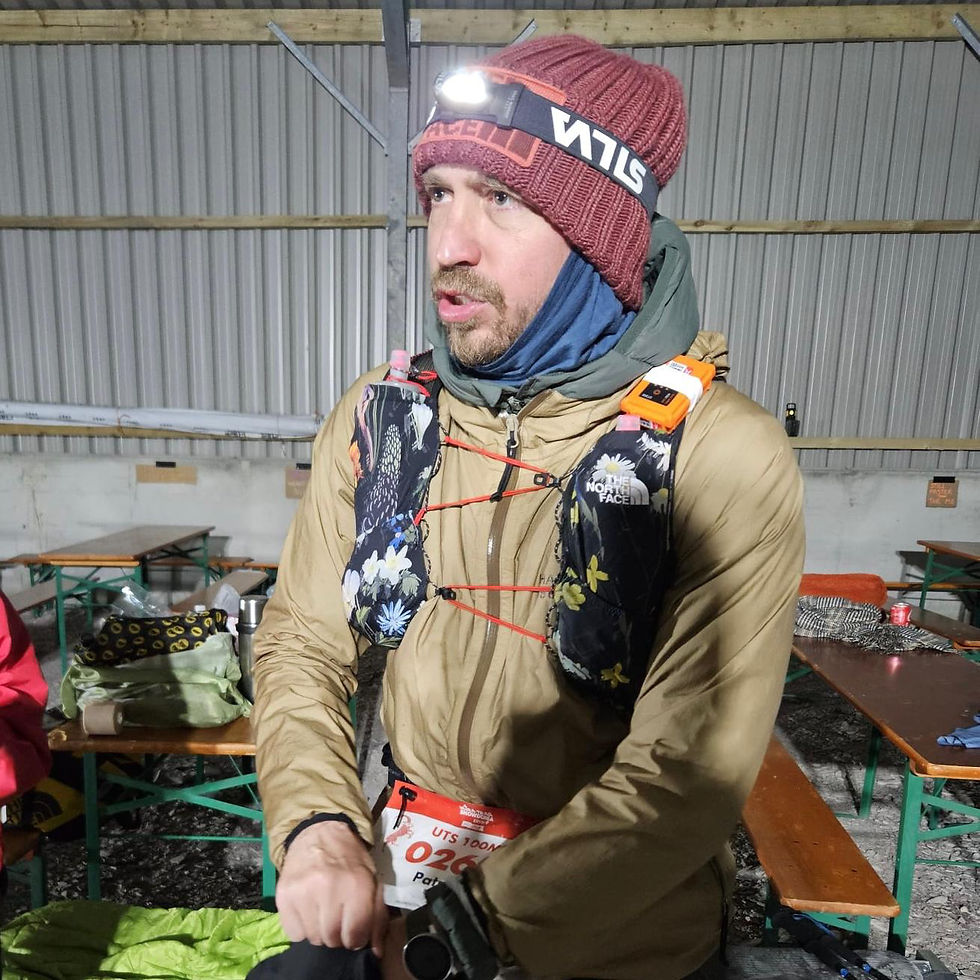
The steps were clear: wet clothes off, dry clothes on. Feet out, air them. Warm food,
blankets, rest.
Together with my crew, we decided on 15 minutes of sleep.
They rolled me up like a cocoon, and I was out before I went horizontal.
Normally, something beautiful comes out of a cocoon.
In this case, what came out was an absolute car crash of a human being.
I had to think twice about where I was. Then reality slowly came back.
You know that feeling when you’re lying in a warm bed, knowing you have to leave the
warm duvet and step into a freezing room in your tighty whities?
I had that feeling.
Just amplified to the absolute breaking point.
But my wife and mum got me dressed and patched me up. I still had around 24 km to go, with two big climbs left.
At that point, 24 km might as well have been the distance from London to Rome. It
seemed impossibly far. Completely overwhelming.
A volunteer came over, and we talked through what I could expect from the next
sections. First, a steep climb. Then a slow descent into the final aid station. Then one
last steady climb to the final peak. After that, the end would finally be within reach.
Knowing I was getting close helped. I felt something shift in my mind. I stopped thinking about the whole distance and started breaking it down into small, manageable pieces.
One climb. One descent. One aid station. One more climb.
That was it.
I got all my layers on. Gloves. Hat. The sun was coming up, and the rain had started to
fade.
Last big push.
Here we go.
The last two climbs were tough, but compared to what had come before, they were
manageable. I knew that if I just kept moving, I would get through them.
Of course, they still came with the usual gifts: mud, slippery rocks, false summits, and a
few moments where I thought the climbing was done, only to look up and see several
more big lumps in the distance waiting for me.
But eventually, with around 8 km left on my GPS, I hit a gravel road with a comfortable
descent where I could finally push the pace.
The sun had come out. The weather was suddenly absolutely beautiful.
A perfect way to end the race.

When the finish line finally came into sight and the spectators started cheering, the
feeling was overwhelming. 45 hours, 41 minutes and 41 seconds I had been on the
move, with a total of 25 minutes of sleep. It felt unreal that I had finished something so
massive.
I felt pride. Relief. Gratitude.
Because without my wife and mum crewing me, and without my coaches Davy and
Darren helping me prepare, I simply would not have made it. That is not me being polite.
That is just the truth.
It is hard to write a thank-you big enough to explain what it meant to have the right
people around me. People who believed, just as much as I did, that a finish was
possible.
The volunteers, mountain rescue teams, and fellow runners also deserve the biggest
thank-you. I did not meet a single person out there who wasn’t absolutely awesome.
It is deeply inspiring to be around people with values and mindsets like that. People who show up, help, suffer, encourage, and keep going.
And to everyone who sent me messages, voice notes, and support: thank you so much. I simply did not have the energy to reply during the race, but I read the messages, and
they meant the world to me.
Now it’s time to have a beer, enjoy the summer, and start looking forward to the next big thing.


Comments